East Bay Teachers' Union
American PrometheusThe East Bay Teachers' Union was a labor organization whose Local 349 became a rare vehicle for collective activity among University of California faculty. Its work joined labor organizing to the politics of the university: at a time when most Berkeley academics avoided unions, professors and teaching assistants met, recruited members, and took on the unglamorous work of building an organization.
Formation and Membership
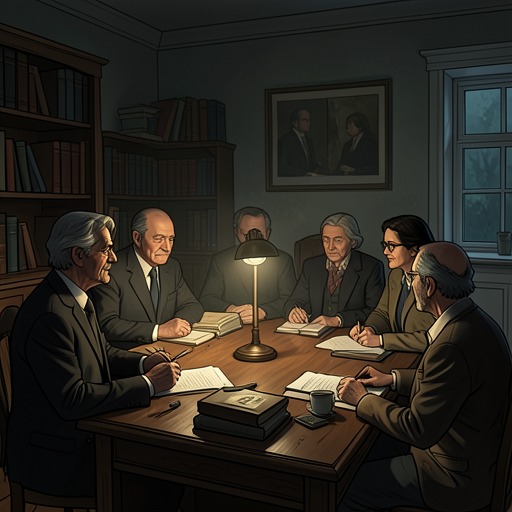
Local 349 was affiliated with the American Federation of Labor. In the autumn of 1935, it expanded to admit university professors. A group of faculty members discussed the proposal over lunch at the Faculty Club or elsewhere on campus and decided to establish the new arrangement. Within a few months, the local had about one hundred members, including forty professors or teaching assistants.
J. Robert Oppenheimer was elected recording secretary; Haakon Chevalier later became the local’s president. The union also provided the setting for their first meeting. Chevalier later placed that encounter in autumn 1937, but the account that connects it to the union’s early organizing points instead to autumn 1935, when Local 349 began admitting professors. The recollections do not settle the date beyond that discrepancy.
Organizing and Daily Work
The union operated in a skeptical academic environment. Chevalier recalled that the faculty’s small left-wing contingent knew it was frowned upon by senior colleagues, while conservative voices prevailed in faculty-council meetings. Most Berkeley academics wanted little to do with a union. Against that resistance, Oppenheimer worked over the next four years to build Local 349’s membership. Chevalier remembered him as a regular at meetings who could be counted on for the most routine tasks, including staying up until two in the morning to address envelopes for a mailing to several hundred members.
The organizing could be laborious and publicly discouraging. At an Oakland High School auditorium, Oppenheimer was advertised as the featured speaker for a union event expected to draw hundreds of public-school teachers. Fewer than a dozen people attended. He made the case for the union anyway, speaking so softly that the audience could hardly hear him. The episode captures both the limits of the local’s reach and the persistence required to keep its appeal before potential members.
Political and Community Activity
Oppenheimer’s union work formed part of a wider pattern of political engagement, but the union itself is most clearly visible in the evidence as a site of faculty organizing. His younger brother, Frank Oppenheimer, was active in Local 349 as well as in the Consumers Union and causes involving migratory farm workers. Frank’s political life also included a flute recital in Pasadena, with Ruth Tolman at the piano, whose proceeds went to the Spanish Republic; the account does not identify the recital as a union event.
Local 349’s significance lay in making organized labor a practical, if unpopular, part of academic life. Its early membership brought faculty and teaching assistants together, while the work of recruiting, meeting, and handling routine administration tested whether that small constituency could endure. Oppenheimer’s steady participation, from union office to envelope-addressing and a sparsely attended public meeting, shows the organization being built through repeated acts of labor rather than broad institutional acceptance.